Abraham Lincoln Presidential Library and Museum
— Lincoln Unlocked
Museums have always asked visitors to show up. To walk through a space, read the placards, absorb what they can, and leave having learned something. The best ones create a feeling — of proximity to history, of understanding a life or a moment or a movement in a way that a textbook never quite manages. But the experience has limits. You can only put so much on a wall. You can only ask so much of a visitor's imagination. And you can only display a fraction of what lives in a collection, constrained by physical space and the delicate realities of preservation.
The Abraham Lincoln Presidential Library and Museum had been at the forefront of reimagining the museum environment since it opened in 2005 — multi-sensory spaces, innovative exhibits, a reputation for doing things differently. In 2024, they wanted to go further. To use augmented reality to create experiences that no physical exhibit could replicate. To reach younger audiences, diverse audiences, families who learn together. To bring stories to life — including the ones that deserved more space than the walls could give them.
The risk was real. AR used poorly doesn't just disappoint — it alienates. It gets in the way of the very connection it's supposed to create. The brief wasn't just to build something technically impressive. It was to build something that earned its place in a space people come to because they care about history.
That was the brief. We built Lincoln Unlocked.
Where we started
We began where we always begin — with the people who would actually use it. Visitor research, interviews, discovery work that grounded every subsequent decision in real human goals, pain points, and interests. The museum's educational priorities were equally present in the room from day one. Every AR experience had to serve the learning, not overshadow it. Technology in service of the story, not the other way around.
Building the team, building the foundation
The first thing I did was staff the team with intention. I had three spots to fill and a clear picture of what the work would demand.
Kara Saje came in carrying the creative and visual knowhow from the pursuit phase — she had already lived the early vision of this project and brought that continuity with her from day one. Together, Kara and Juan were the powerhouse that made our branding work possible — the creative engine that gave Lincoln Unlocked its visual identity and its soul. (Kara has a level of creativity that leaves me breathless — check her out.)
Juan Trapp could bridge the space between visual and UX with a fluency that a project this hybrid in nature demanded. (Juan is easily one of the sharpest visual designers I've ever met — check him out.)
And for the UX foundation I brought in Kira Davies, someone I'd worked with on a previous engagement and trusted completely to help anchor our design approach from the ground up. (Kira has an unmatched work ethic and design ethos — check her out.)
I knew what I needed and I built the team to balance it — the known work and the unknowns that come with designing for AR and XR at this scale, for this kind of audience, for the first time. That balance meant we could move into genuinely unfamiliar territory without losing our footing.
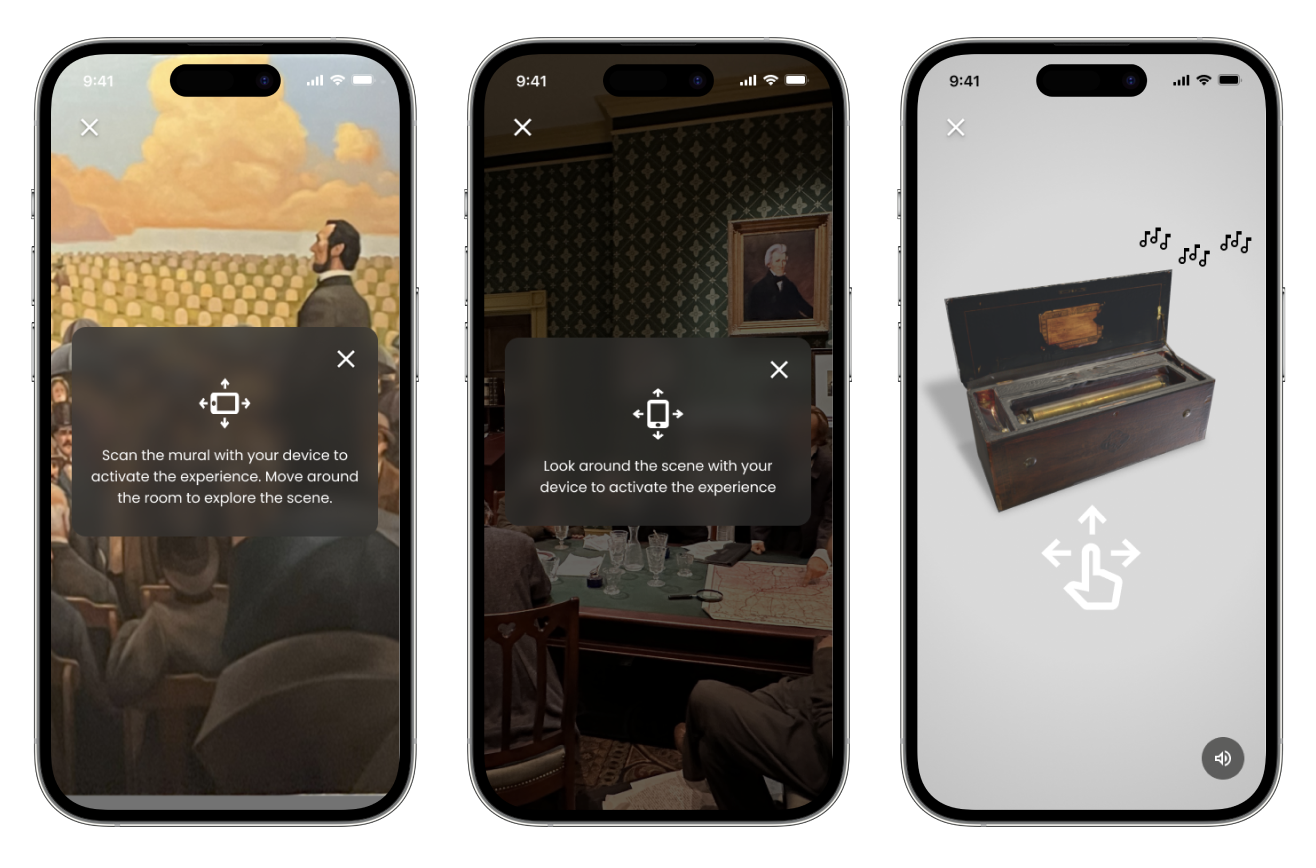
We also needed to go beyond our own team. One of the most immersive experiences in the app — the Gettysburg Address sequence, where scanning a mural triggers it coming to life with animation, sound, and movement as the speech plays — required animation and 3D artistry beyond what we had in house. I ran a process to find and hire an external XR animation contractor: interviewing artists, reviewing portfolios, understanding exactly how they'd approach work none of us had fully done before. Managing them turned out to be one of the most unexpectedly valuable experiences of the project. They were so adept at 3D design and animation that they taught us — the design team — a wealth of things about how to plan, ideate, and execute this kind of work. A reminder I carry with me: you don't know what you don't know, and the right collaborator doesn't just fill a gap, they expand what you thought was possible.
Lincoln Unlocked — designing wonder, accessibly
The app needed to be two things at once: flexible enough to present any type of content across any themed tour structure the museum might want, and extensible enough to grow with the institution over time. Those aren't just technical requirements — they're design constraints that shaped every decision we made about architecture, content structure, and experience flow.
The experiences we built inside that architecture were genuinely unlike anything we'd designed before.
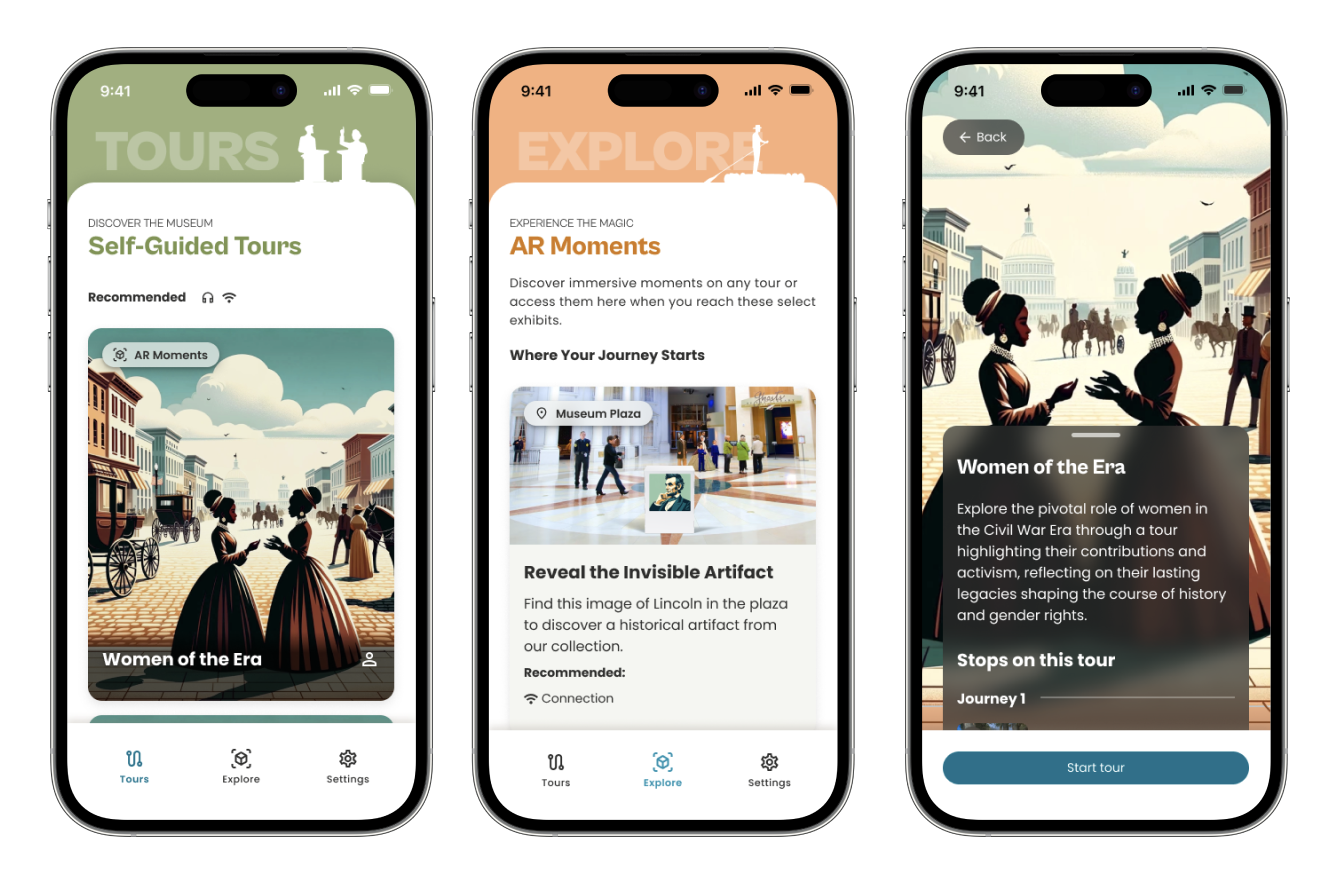
Visitors could bring their phone's camera to a symbol and watch a digital replica of a historical artifact appear — rotating it, examining it from every angle, holding a piece of history that preservation rules would never allow them to touch in real life. Mary Lincoln's music box, for instance — wind it up, and hear the same music Mary would have heard in the 1860s. Two full interactive spaces layered digital experiences onto physical rooms through the camera — characters to tap, sound bites to trigger from digitally rendered objects, stories unlocked by where you were standing in the museum. And the Gettysburg Address — scan the mural, and watch history come alive.
The thematic tours followed the physically designed space of the museum across two journeys, guiding visitors through Lincoln's life room by room, era by era. The app was a companion to that physical space — deepening it, extending it, making the stories and artifacts of the collection accessible in ways the physical environment alone never could.
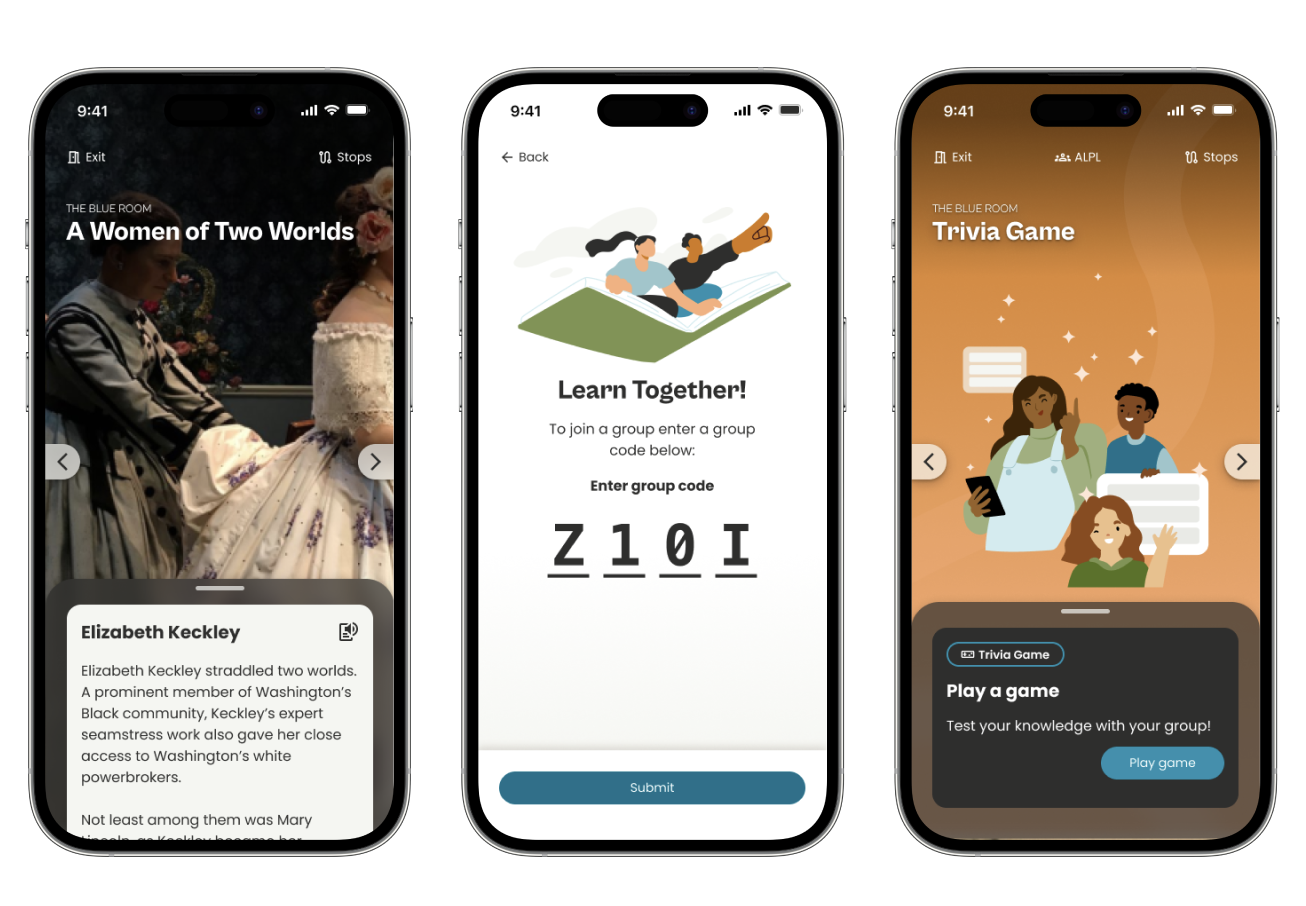
We also designed for the people who keep that experience running. The content management system we built gave museum staff the ability to update exhibits, rotate artifacts, and deliver content in six languages — all without touching a line of code. Because a great visitor experience doesn't sustain itself. It requires the people behind the scenes to have tools designed with the same care and intention as the things visitors see. We designed for both.
Accessibility was a core principle throughout, not an afterthought. Closed captioning, text-to-speech, multilingual support, and AR experiences designed from the ground up to deliver value to every visitor regardless of ability, age, or comfort with technology. Designing for the edges of accessibility in an AR context pushed us to be more creative, more intentional, and more human in every decision. It always does.
And we designed the experience so that the content could highlight the stories that needed to be told. The women who shaped the Lincoln era. First-hand accounts of resistance and survival. Voices that history has too often left in the margins, given the space and the medium they deserved.
The trust that made it possible
What made all of this achievable was something that had nothing to do with technology. We could only make site visits to the museum once a month. The team had to be able to design and test deeply spatial, deeply physical AR experiences remotely — and then come together quickly on site to ideate, pressure-test, and extend our ideas in the real space. That kind of working relationship doesn't happen automatically. It's built through clear expectations, radical transparency, and enough shared experience that the team can anticipate each other's thinking even when they're not in the same room.
I had the largest design team I'd ever managed on this project. Four strong, deeply talented designers with genuinely different perspectives and skills. It was a dream — not because it was easy, but because of what we were able to build together. The people made it the best part. They always do.
The sabbatical
Midway through the project, I left for a three-month sabbatical.
The design principal. The person leading the team, holding the vision, managing the client relationships, anchoring the cross-functional work. Gone for three months.
I could do that because of everything that was already in place. The team knew the design strategy cold. They had internalized the principles. The work was planned far enough ahead. Most importantly — they knew my perspective, my ethos, my direction so completely that they didn't need me in the room to make good decisions. They were already making them.
I didn't worry once. Not because I was disconnected from the work, but because I had built something that didn't depend on my constant presence to function. A team that trusted each other, communicated openly, and had the craft and the clarity to keep moving without me.
When I came back, the work was still running. Still good. Still theirs.
I have never been more proud of anything I've built as a leader.
What this project taught me
The best design teams aren't built around a leader. They're built around shared values, mutual trust, and a clarity of direction that outlasts any single person's presence. My job was never to be indispensable. It was to make myself unnecessary — to grow a team so capable and so aligned that stepping back wasn't a risk, it was just a thing that happened.
Lincoln Unlocked reaches 200,000+ annual visitors. It's setting a new benchmark for how cultural institutions use AR to create experiences that are genuinely educational, genuinely accessible, and genuinely moving.
But the thing I think about most isn't the mural coming to life or the music box or the Gettysburg Address playing through someone's phone in a room designed to look like the 1860s. It's Kara and Juan and Kira, doing extraordinary work, laughing their heads off, in a room I wasn't even in.
That's the mission.